Abstract
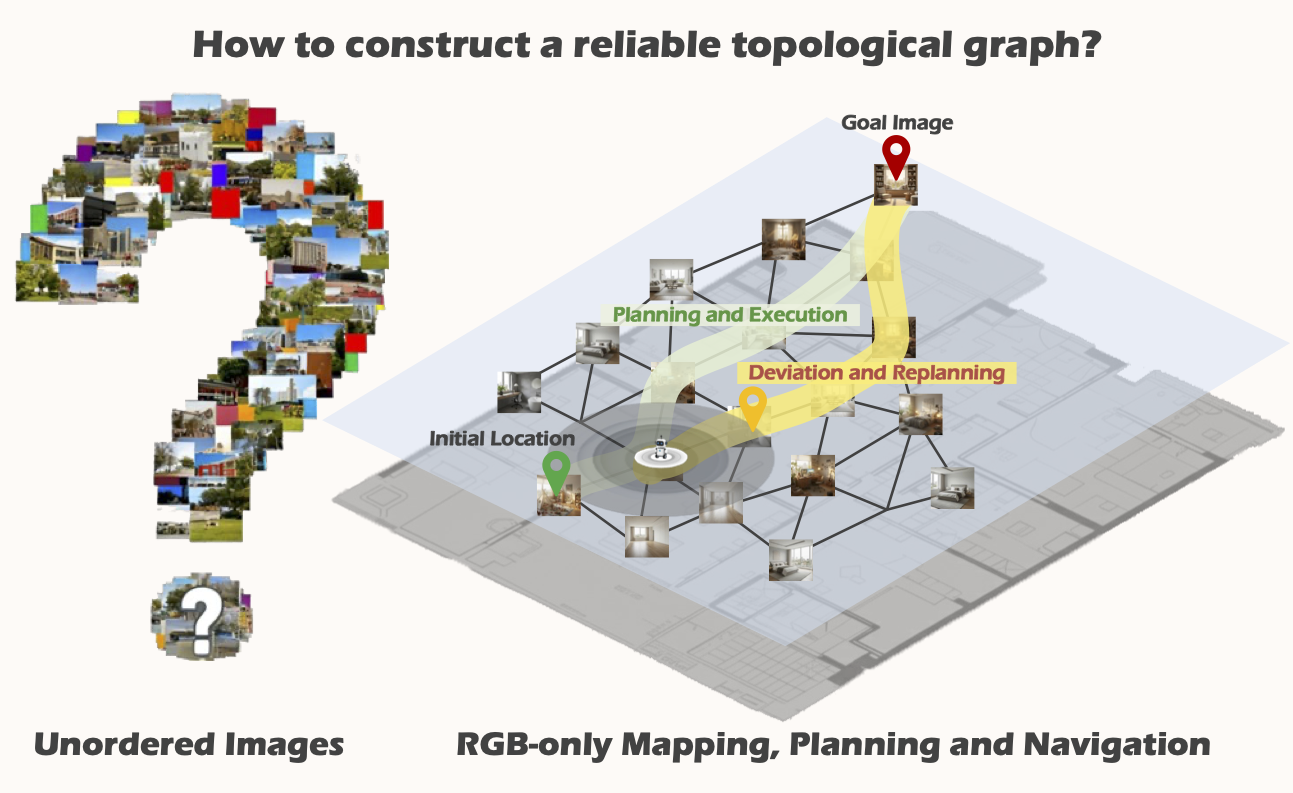
Image-goal navigation is a fundamental capability for embodied AI, yet most existing systems rely on temporally ordered video streams, odometry, depth, or LiDAR to preserve spatial consistency. These assumptions restrict deployment when robots must operate from crowd-sourced or pre-recorded unordered image collections. We propose Unordered Landmark Visual Navigation (ULVN), a unified RGB-only framework that integrates mapping, localization, and planning without temporal or multimodal priors. ULVN constructs a robust 2D topological map from unstructured images through calibrated visual place retrieval, geometric verification, maximum spanning forest refinement, and loop reinsertion. During closed-loop execution, a graph-based belief propagation localization filter uses entropy-adaptive fusion to track the robot under perceptual ambiguity, while belief-aware subgoal search plans and replans over the graph. Experiments in simulation and real-world robot deployments show that ULVN substantially improves mapping quality, localization robustness, and navigation success over strong baselines.
Effect of Temporal Order on Scene Reconstruction
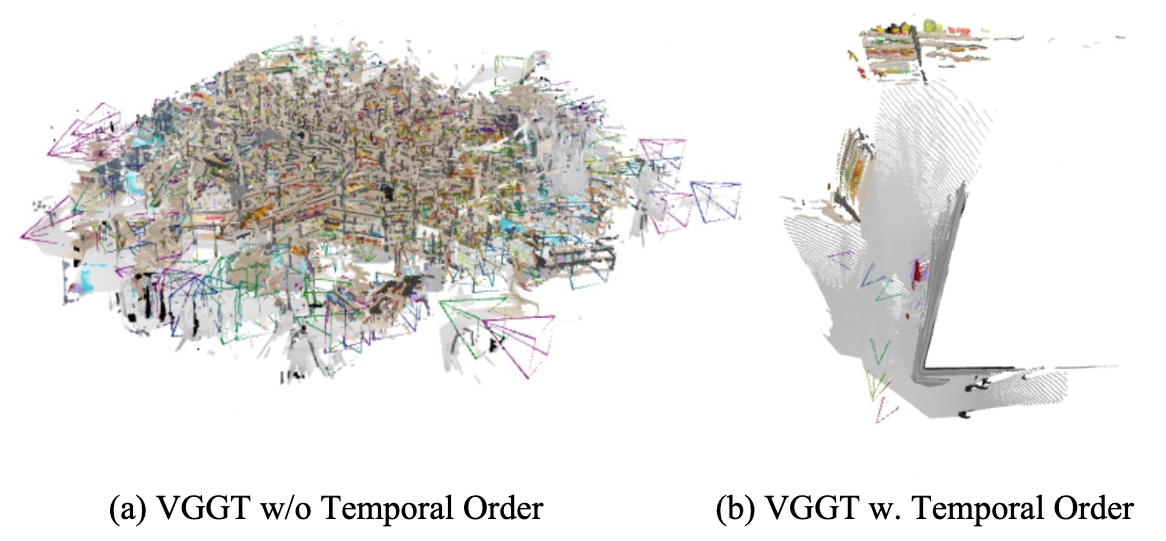
We compare VGGT reconstructions with and without temporal order to assess its dependence on sequential priors. Without temporal order, the reconstruction is fragmented and noisy, whereas temporal ordering produces a more coherent and geometrically consistent scene structure.
Method
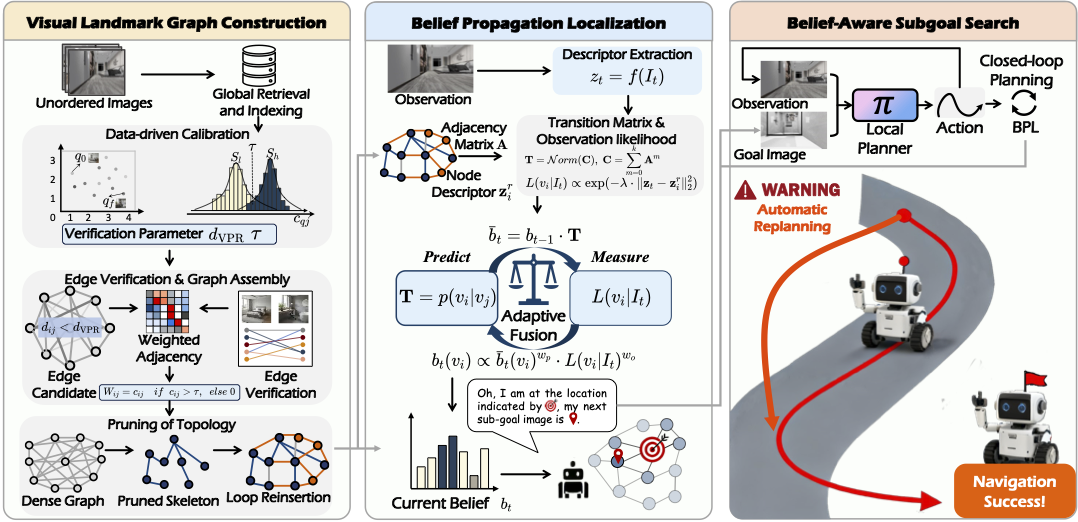
ULVN contains three coupled components.
RAVEL converts unordered images into a reliable landmark graph. It uses visual place retrieval for high-recall candidate discovery, calibrates verification thresholds from the data, verifies local geometry with feature inliers, extracts a maximum spanning forest to keep the strongest navigation backbone, and reinserts strong loop closures to preserve useful cyclic structure.
BPL performs odometry-free localization on the resulting 2D graph. It propagates belief through graph reachability, measures observation likelihood with visual descriptors, and fuses prediction and observation through entropy-adaptive weights so that uncertain observations can lean more heavily on topology.
BASS turns the belief state into closed-loop navigation. It anchors the start and goal images on the graph, searches for the widest path whose weakest visual transition is maximized, sends sequential landmark subgoals to a local visual planner, and triggers replanning when the belief moves away from the intended route.
Results
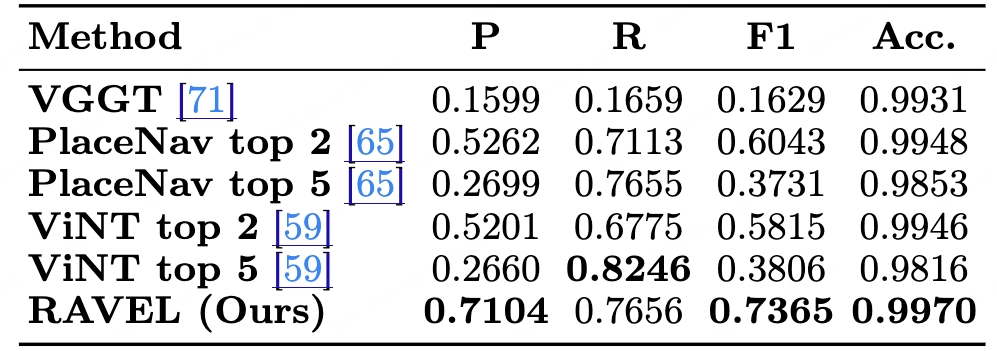
On GRScenes, RAVEL achieves the strongest topological graph construction performance among the evaluated baselines, reaching 0.7104 precision, 0.7656 recall, 0.7365 F1, and 0.9970 accuracy. Compared with top-k retrieval and temporal-distance proxies, the calibrated geometric verification plus MSF refinement provides a better precision-recall balance for unordered maps.
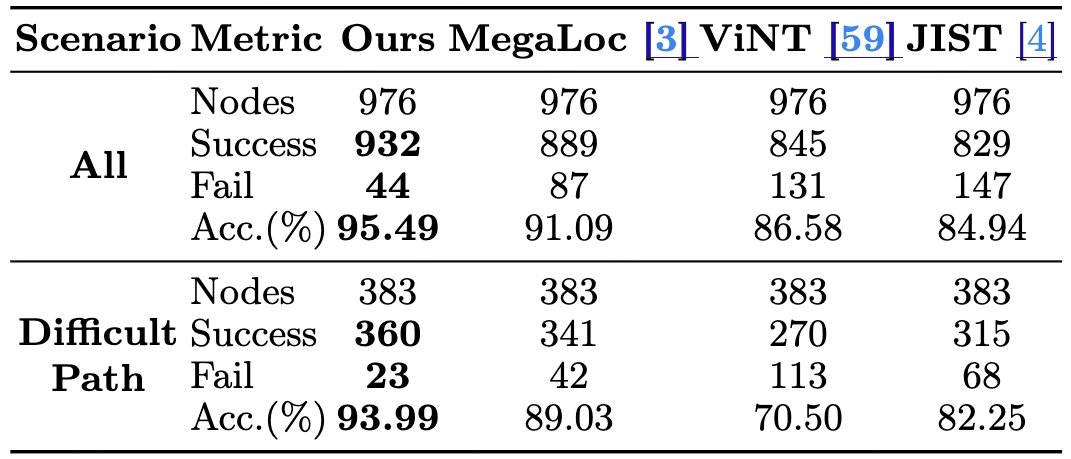
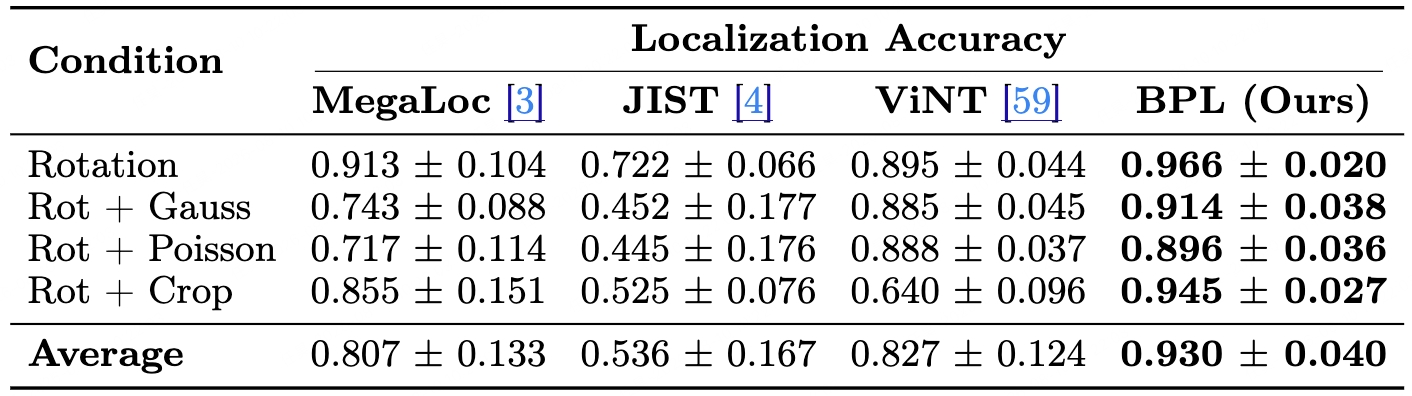
For global localization, BPL achieves 95.49% accuracy in the global setting and 93.99% on difficult paths with long routes, turns, and low start-goal visual overlap. Under viewpoint shifts, Gaussian noise, Poisson noise, and random cropping, BPL averages 0.930 +/- 0.040 localization accuracy across four datasets, outperforming MegaLoc, JIST, and ViNT.
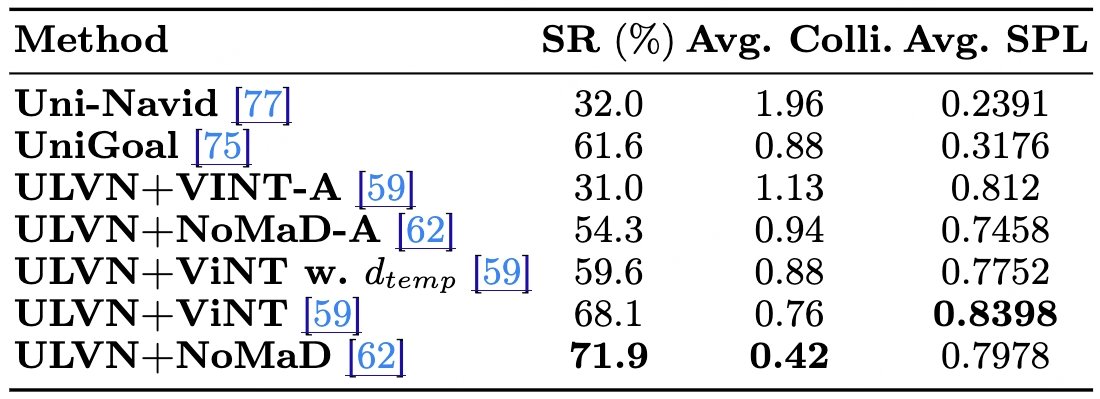
For navigation, ULVN improves over purely reactive baselines. Integrated with NoMaD, ULVN reaches 71.9% success rate, 0.42 average collisions, and 0.7978 SPL on GRScenes; with ViNT, it reaches 68.1% success rate and 0.8398 SPL. The results indicate that lightweight topological memory reduces myopic oscillation and supports recovery from off-route execution.
Global Descriptors as Proxies for Geometric Verification
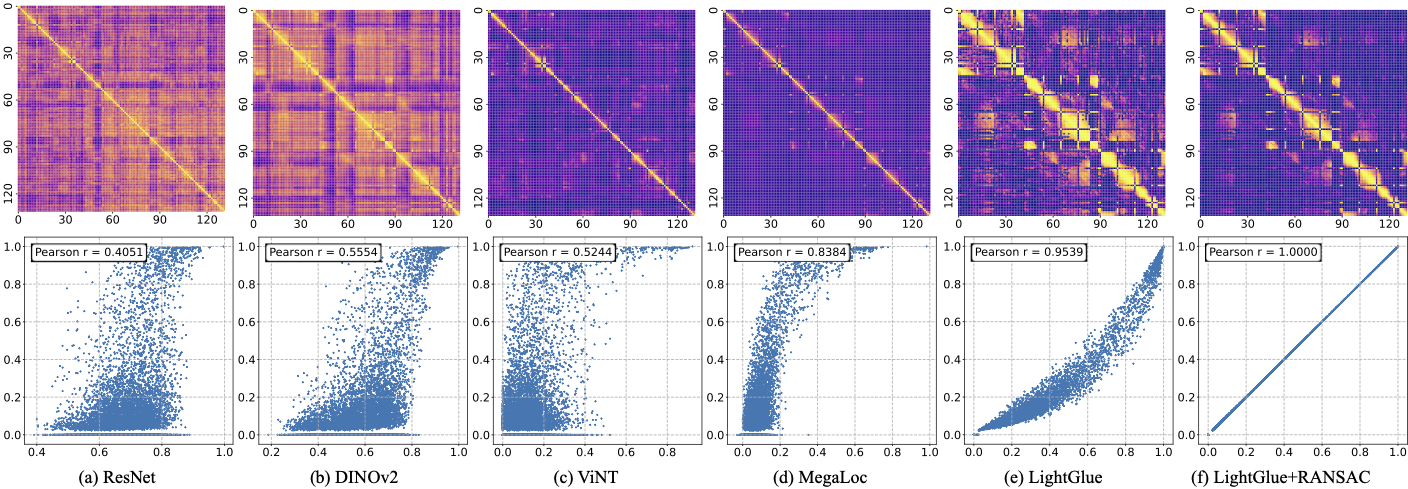
We evaluate whether global descriptors can efficiently approximate costly geometric verification. On CARLA data, ResNet, DINOv2, and ViNT show weak or non-linear correlations with LightGlue+RANSAC geometric scores, while the VPR-trained MegaLoc exhibits a strong correlation, making it a reliable proxy for fast candidate retrieval.
Mapping Performance Evaluation
We compare RAVEL with retrieval-based baselines on GRScenes. Increasing Top-k improves recall but substantially reduces precision, while RAVEL achieves a better balance through structural verification, obtaining the highest precision, F1-score, and accuracy.
Robustness of RAVEL to Visual Perturbations
We evaluate mapping robustness under lighting changes, noise, and motion blur. Retrieval-based methods suffer substantial precision and F1 degradation, whereas RAVEL remains robust due to geometric verification and global structural constraints.

Global Localization Performance
We compare BPL with MegaLoc, ViNT, and JIST on global localization. BPL achieves the highest accuracy on both overall and difficult trajectories, with particularly strong performance on challenging paths containing turns, intersections, and loops.
Robustness to Perceptual Degradation
We evaluate localization under viewpoint shifts, image noise, and structural cropping across four datasets. BPL consistently outperforms MegaLoc, JIST, and ViNT, maintaining high and stable accuracy under all degradation conditions.
Navigation Performance Evaluation
We compare ULVN with end-to-end baselines and different local planner variants. ULVN consistently improves navigation performance, with NoMaD achieving the highest success rate and lowest collision count, while ViNT achieves the best SPL.
Navigation with Dynamic Replanning
We visualize closed-loop navigation in the home environment. The robot follows the initial topological path and automatically recovers from execution deviations through BPL-based localization and replanning.

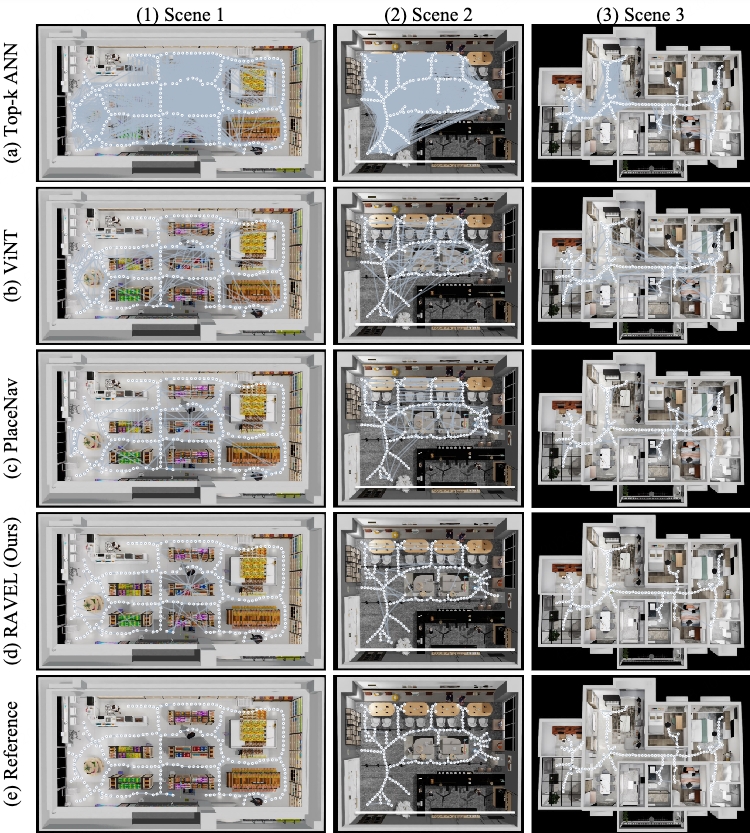
Qualitative Analysis of Topological Graph Construction
We compare topological graphs generated by different methods against the reference graph across multiple scenes. Retrieval-based and temporal approaches introduce noisy connections and obstacle-crossing edges, while RAVEL produces sparse and geometrically consistent structures.
Real-World Deployment
ULVN was deployed on a Diablo wheeled robot equipped with an Azure Kinect camera and an NVIDIA Jetson Orin. In representative real-world trials, the robot followed a planned visual landmark route, detected physical deviation through the BPL belief state, and used BASS to replan from the off-route node to the goal. This validates the sim-to-real viability of RGB-only, odometry-free navigation from unordered landmarks.
BibTeX
@article{ren2026ulvn,
  title={Unordered Landmark Visual Navigation},
  author={Ren, Hao and Zhu, Junzhe and Li, Yihan and Bi, Zetong and Zheng, Le and Li, Zhi and Yuan, Yiqing and Wan, Zhaoliang and Zhang, Dizhe and Qi, Lu and Cheng, Hui},
  journal={arXiv preprint arXiv:2608.06833},
  year={2026}
}